
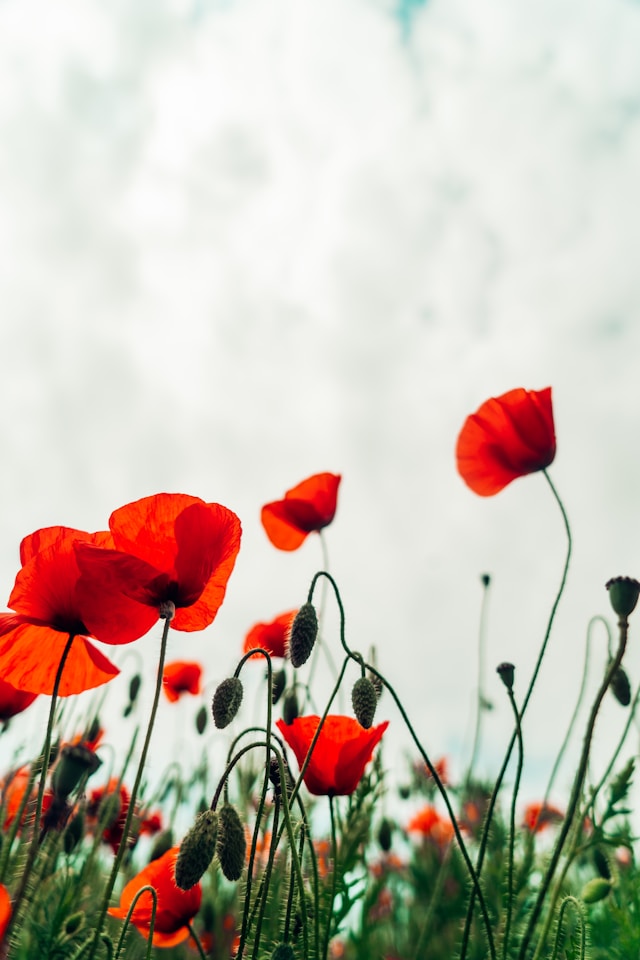
The orange poppy symbolizes remembrance and the fleeting nature of life
My poppies have never been bigger or brighter; their orange petals burst from their pods within days and are now spent. They come up every year in early June, their crepe paper petals so delicate they can be knocked from their stems by a gentle rain. They don’t last more than a week, leaving orange and indigo remains at the feet of their jagged and hairy leaves, parted and prone. Their life cycle endures without my interference.
Poppies’ fleeting presence is a perfect foretelling of summer, and life—too short.
Summertime is for all those things we wait for, boat rides, bike rides, potlucks with the neighbors, garden produce, an open book, lawn chair and peachy green iced tea. It is for walking the beach, popsicles and ice cream, carnivals, festivals and cabin time. I miss my parents, especially in June, their birthday month. In retirement Mom and Dad moved closer to us, after they sold the rambler of my childhood, trading it for a two-story house with a pool in the next neighborhood. When the kids were old enough to take the shortcut between our houses, they spent afternoons there, swimming, playing Mario Brothers in the basement and drinking pop from the fridge Dad stocked with their favorites. Mom served up P B & J sandwiches and overlooked wet swimsuits.
It was summertime when they were both diagnosed with cancer, and spent their last days at home, in hospice care. Dad died over ten years ago, in June of 2014, and Mom in August 2017, forever marking the beginning and the end of Summer.
Lately, I have been thinking about the long arc of time, and my tiny speck on it, measured in years and decades that swiftly add up to a lifetime. Now that I am nearing 70, I have new “tags” to mark me—mature woman, grandmother, retiree, elder. It is easy to claim that our lives will continue as they always have and ignore the fact that we have limits to our existence.
Connie Zweig in her book “The Inner Work of Age: Shifting from Role to Soul ,” has made me aware of my resistance to claim ‘later’ life. She says, “You now have the chance to leave behind past roles, shift from outer work to inner work, and become authentically who you are.” It is now that we can grow personally and spiritually. David Brooks in his 2020 TED Talk urges us to do the same—live a life of meaning, focus less on resume values and more on eulogy values.
Poppies bring me back to Ireland—fields and gardens swaying with orange
Mom, my sister and our daughters traveled to Ireland to find the roots of our Irish relatives in County Wicklow, the home of our Fitsharris ancestors who fled to America during the potato blight years. Mom was thrilled to make the trip, retelling stories of Uncle Peter’s just-in-time jail break to board a ship to meet his brothers in Ohio, and then claim acreage in Pierce, County, Wisconsin. A year later, Aunt Julia followed with the children, wondering if she would be let on the ship, her babe in arms spotted with measles. Their presence was felt when we stood before their cottage, a spiritual connection of time and place. The “Harrises” (no more Fits) would settle near Peter’s brothers, their plots adjoining at a crossroads which became known as Harris Corner. Mom’s grandmother was Peter and Julia’s youngest child.
Memorial Day has passed but I feel the need to make a trip to Wisconsin to tend my parents’ graves. They are buried in the same plot with generations of the Harris clan who immigrated all those years ago, the headstones marking our family’s presence on the land.
The orange poppy symbolizes remembrance, resilience, and peace.
The poet John McCrae, a Canadian Physician and WWI soldier wrote “In Flanders Fields,” one of the world’s most recognized war poems and anthem for remembrance, making the poppy a symbol to honor the war dead.
My nephew, Colin, at 8-years old sang In Flanders Fields for us when our family visited him in Canada. I will always remember his clear solo voice carrying the sweet melody and weighty words of the text, protected by his innocence of the horror and ruin of war.
Scarce heard amid the guns below.
We are the dead, short days ago
We lived, felt dawn, saw sunset glow,
Loved and were loved, and now we lie in Flanders Fields
The recorded history of the poppy flower dates to 2700 BC, when it was cultivated for its medicinal and recreational use as a mild sedative. Native throughout the world, the poppy can be grown as an annual, biennial, or perennial plant, reaching full bloom in late spring or early summer. It is cultivated for seed, oil, and pharmaceuticals.
Orange is a controversial color. People tend to either love it or hate it. It is statistically the least favorite color on surveys and associated with negative qualities of crassness, rudeness and frivolity.
Orange is associated with the sacral chakra, located in the hips, the seat of emotional energy.
At this time of war, let orange be a remembrance and symbol of hope that the world can experience long-lasting peace. Remember the people in your family who may have served or died in a conflict. Remember the importance of peace.


Lovely, Debra! So good to hear from you!
Thank you.
Love, Marge
LikeLiked by 1 person
Lovely, Debra! Thank you for these beautiful words!
xoxo
Kate
LikeLike
Lovely, Debra. Thank you for these beautiful words!
xo
Kate
LikeLiked by 1 person
❤️ You definitely have a way with words.
LikeLiked by 1 person
Beautiful, Debra. I love “Lately, I have been thinking about the long arc of time, and my tiny speck on it, measured in years and decades that swiftly add up to a lifetime. ” This is a gorgeous sentence and it makes me reflect upon my own tiny speck.
LikeLiked by 1 person
Debra, so much to think about in this post! I don’t think I’ve ever seen poppies growing in someone’s yard. How beautiful they must be in yours! Tending graves–just this morning I was thinking that it’s time again to family graves. The inner work of age. The color orange as a symbol of hope. (I recently bought an orange skirt, completely out of character for me, but now I’m going to wear it boldly, in hope!) Thank you for sharing this writing!
xo
LikeLike